Discovering Germany’s Hidden Gems: Beyond the Famous Landmarks


Destination (from India)
Dates of Travel (optional)
List of Content
Introduction
Germany is home to some of Europe's most famous attractions, from the Brandenburg Gate in Berlin to the fairytale towers of Neuschwanstein Castle. But if you're willing to venture beyond the usual tourist trail, you'll discover a different side of the country that's just as rewarding.
Picture medieval towns with cobbled streets, peaceful lakes, dramatic mountains, charming wine villages, and islands where bicycles are the preferred mode of transport. These lesser-known destinations offer a chance to slow down, explore at your own pace, and experience local culture away from the crowds.
If you're planning a trip to Germany, here are some hidden gems that deserve a spot on your itinerary.
1. Spreewald, Brandenburg
Less than two hours from Berlin, Spreewald feels like a completely different world.
This UNESCO Biosphere Reserve is crisscrossed by hundreds of narrow waterways, where boats are often a more practical way to get around than cars. Visitors can take a traditional punt boat through peaceful canals, cycle along scenic trails, or stop at small villages known for preserving the traditions of the Sorbian community, one of Germany's recognised Slavic minorities.
While you're there, don't miss the region's famous Spreewald pickles, a local speciality that's become a symbol of the area.
2. Rakotzbrücke (Devil's Bridge), Saxony
Hidden within Kromlau Park is one of Germany's most photographed bridges.
Rakotzbrücke, often called Devil's Bridge, was designed to create a perfect circle when reflected in the calm waters below. The result is a stunning optical illusion that has fascinated visitors for generations.
To help preserve this historic structure, visitors are no longer allowed to walk across the bridge. Instead, admire it from the surrounding paths, which offer some excellent viewpoints for photography.
3. The Harz Mountains
The Harz Mountains are filled with dense forests, medieval towns, and stories rooted in German folklore.
One of the highlights is riding the historic Harz Narrow Gauge Railway, where steam trains wind through the mountains towards Brocken, the region's highest peak.
Nearby, the UNESCO-listed town of Quedlinburg is home to more than 1,000 beautifully preserved half-timbered houses, while Wernigerode charms visitors with its colourful town centre and hilltop castle overlooking the surrounding landscape.
4. Görlitz and Meissen
Located near Germany's eastern border, Görlitz is one of the country's best-preserved historic towns.
Its elegant streets feature Gothic, Renaissance, and Art Nouveau architecture, making it a favourite filming location for international movies, including The Grand Budapest Hotel. A short walk across the bridge even takes you into neighbouring Poland.
Further west, Meissen is famous as the birthplace of European porcelain. Visitors can tour the historic porcelain factory, explore the impressive Albrechtsburg Castle, or enjoy views of the vineyards overlooking the Elbe River.
5. Saalfeld Fairy Grottoes
Deep beneath the forests of Thuringia lies one of Germany's most unusual attractions.
The Saalfeld Fairy Grottoes were once mining tunnels but are now famous for their colourful mineral formations. Often described as one of the world's most vibrant cave systems, the illuminated chambers create an almost magical atmosphere that's unlike anything else in Germany.
6. Stralsund, Greifswald and Wismar
Germany's Baltic coast is dotted with historic Hanseatic towns that are often overlooked by international visitors.
Stralsund is known for its impressive brick Gothic architecture, picturesque harbour, and the popular Ozeaneum museum.
Greifswald combines a lively university atmosphere with beautiful historic buildings and the ruins of Eldena Abbey, which inspired many of the paintings of German Romantic artist Caspar David Friedrich.
Wismar, another UNESCO World Heritage city, offers charming market squares, colourful waterfront buildings, and a fascinating history shaped by more than a century of Swedish rule.
7. Mecklenburg Lake District
Nature lovers will feel right at home in the Mecklenburg Lake District.
Home to hundreds of interconnected lakes, rivers, and forests, the region is perfect for kayaking, cycling, hiking, and wildlife spotting.
One of its highlights is Schwerin Castle, an impressive palace surrounded by water that looks as though it belongs in a storybook.
8. Bremen
While many visitors head straight to Munich or Berlin, Bremen quietly rewards those who take the time to explore it.
Its historic market square, UNESCO-listed Town Hall, and famous Bremen Town Musicians statue are just a few of the city's highlights. The riverside promenade is also a great place to relax with a meal or enjoy the local atmosphere.
9. Sylt and Hiddensee
Germany's northern islands offer a completely different kind of holiday.
Sylt is known for its long sandy beaches, rolling dunes, seafood restaurants, and relaxed coastal lifestyle. It's a favourite destination for both nature lovers and those looking to unwind by the sea.
Hiddensee, meanwhile, is entirely car-free. Visitors explore the island by bicycle, horse-drawn carriage, or on foot, making it an ideal escape for anyone seeking peace and quiet.
10. The Eifel Region and Monschau
The Eifel region is known for its volcanic landscapes, crater lakes, forests, and scenic walking trails.
One of its prettiest towns is Monschau, where narrow cobbled streets, timber-framed houses, and riverside cafés create a postcard-worthy setting. It's an excellent place to spend a relaxed afternoon exploring local shops or enjoying traditional German cakes and coffee.
11. The Moselle Valley
The Moselle Valley is often overshadowed by the more famous Rhine, but many travellers find it even more charming.
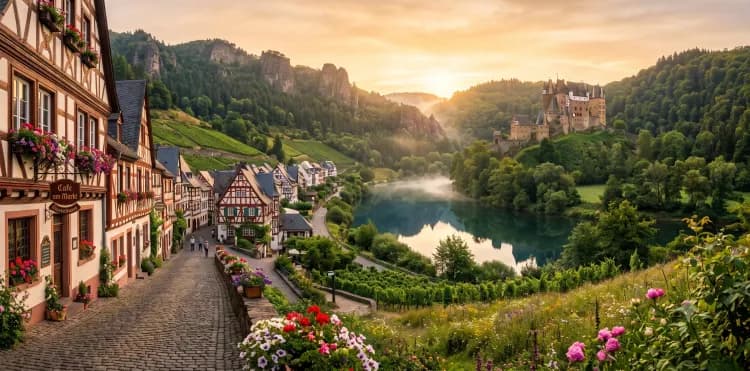
The riverside town of Cochem is surrounded by steep vineyards and overlooked by the striking Reichsburg Castle, creating one of Germany's most picturesque landscapes.
Further along the river lies Trier, Germany's oldest city, where remarkably preserved Roman monuments, including the Porta Nigra, offer a fascinating glimpse into the country's ancient past.
12. Wuppertal
Wuppertal is best known for one very unusual attraction.
Its famous Schwebebahn is the world's oldest electric suspended railway still in operation. Instead of running on tracks below, the trains hang from rails above the streets and river, making the journey an attraction in itself.
It's a fun and unique way to experience a city that many travellers overlook.
13. Dinkelsbühl and Bamberg
If you love medieval towns, don't stop at Rothenburg ob der Tauber.
Dinkelsbühl offers beautifully preserved city walls, colourful buildings, and a quieter atmosphere, allowing visitors to enjoy its historic streets without the large crowds.
Bamberg, a UNESCO World Heritage city spread across seven hills, is equally impressive. Its beautifully preserved Old Town escaped significant wartime damage and is famous for landmarks such as the Altes Rathaus and its distinctive smoked beer, known locally as Rauchbier.
14. Tübingen and Ladenburg
Tübingen combines centuries-old architecture with the lively atmosphere of a university town.
Visitors often enjoy taking a traditional punt boat along the Neckar River before exploring the cafés, bookshops, and narrow streets of the old town.
Nearby Ladenburg is one of Germany's oldest settlements. Its quiet lanes, historic buildings, and relaxed pace make it an excellent stop for travellers looking to experience a more local side of Germany.
15. Passau and Lindau
Located where the Danube, Inn, and Ilz rivers meet, Passau is often called the City of Three Rivers.
Its elegant old town, colourful buildings, and impressive St. Stephen's Cathedral make it one of Bavaria's most beautiful destinations.
Further south, Lindau sits on a small island in Lake Constance. With its historic harbour, lakeside promenade, and views of the Alps in the distance, it's a wonderful place to end a journey through southern Germany.
A Few Tips for Exploring Beyond the Tourist Trail
A little planning can help you get even more out of your trip.
• Visit during spring or autumn if you prefer fewer crowds and pleasant weather.
• Consider renting a car or using Germany's excellent regional trains to reach smaller towns and rural areas.
• Spend a night or two outside the major cities to experience local food, traditional guesthouses, and slower-paced communities.
• Don't be afraid to ask locals for recommendations. Some of the best cafés, walking trails, and viewpoints never appear in guidebooks.
Final Thoughts
Germany's famous landmarks deserve their reputation, but some of its most memorable experiences can be found far from the busiest tourist attractions.
Whether you're drifting through the canals of Spreewald, wandering medieval streets in Quedlinburg, exploring colourful caves in Thuringia, or relaxing beside Lake Constance, these hidden gems reveal a quieter and more authentic side of the country.
If you have the time, consider adding one or two of these destinations to your itinerary. You may discover that they're the places you remember long after your trip comes to an end.
Other topics
Explore and Discover
The Ultimate 8-Day Iceland Winter Adventure: Chasing the Northern Lights and Exploring Glaciers
Thursday, Jul 9, 2026
Embark on the ultimate 8-day Iceland winter adventure, where breathtaking glaciers, dramatic waterfalls, volcanic landscapes, and the magical Northern Lights await.
Travel Agent Insight – UK Visa Process
Thursday, Apr 30, 2026
Navigating the UK visa process can feel overwhelming, especially with evolving regulations and documentation requirements. For travel agents, having a clear understanding of visa categories, eligibility criteria, and application procedures is essential to providing reliable guidance to clients.