Eco-Friendly Travel: Sustainable Practices for a Greener Journey


Destination (from India)
Dates of Travel (optional)
List of Content
Introduction
There's a small but telling moment that happens to many travellers at the airport. You've got your digital boarding pass pulled up, your reusable bottle freshly filled at the terminal water station, and you feel reasonably good about yourself. Then you watch your checked bag disappear onto the belt - stuffed with four pairs of shoes you probably won't wear, three extra jackets just in case, and enough single-use toiletry sachets to last a small village through monsoon season.
Sustainable travel doesn't require you to fly economy with a lentil curry packed in a bamboo tiffin box. It's not about guilt, lectures, or giving up the things that make travel enjoyable. It's simply about being a little more thoughtful with the choices that are easy to make better - and understanding that millions of small decisions, made by millions of travellers, genuinely add up to something meaningful.
Here's how to travel more responsibly without sacrificing the trip you've been planning for months.
What Is Sustainable Travel, Actually?
The phrase "sustainable travel" has been co-opted by so many hotel marketing teams and airline carbon offset programmes that it can feel meaningless. But at its core, the idea is straightforward: travelling in a way that minimises harm to the environment, respects local cultures, and ideally contributes something positive to the communities you visit.
That's it. No need for certification courses or expensive carbon calculators.
The point isn't to be a perfect traveller - that person doesn't exist. The point is to make better choices when those choices are genuinely available to you. Take public transport instead of a taxi when it's convenient. Eat at a family-run restaurant instead of a global chain when the food is just as good. Refill your bottle instead of buying a new plastic one at every stop. None of these things require sacrifice. Many of them actually improve the experience.
Choose Direct Flights When You Can
Flying is the single largest contributor to most travellers' carbon footprint, and there's no perfect solution to that. But one practical step that often gets overlooked is the impact of take-offs and landings versus cruise altitude. Take-offs and landings are among the most fuel-intensive phases of a flight, which is one reason direct routes can sometimes have a lower environmental impact than multiple connecting flights.
That said, direct flights aren't always cheaper, and budget is a real constraint for most travellers. This isn't a rule to follow rigidly; it's a factor worth considering when two options are otherwise similar in price and timing.
If you do offset your flight emissions, look for programmes with verifiable projects rather than vague promises - organisations like Gold Standard certify carbon offset schemes independently, which gives them more credibility than a generic "we plant trees" checkbox at checkout.
Pack Smarter, Fly Lighter
A heavier plane burns more fuel. That's not a metaphor - it's aerodynamics. And while one person's extra pair of shoes won't ground a 777, the collective effect of millions of overpacked bags across thousands of flights every day adds up.
More practically: lighter packing makes your trip better. You move faster, check in quicker, avoid baggage fees on budget airlines, and never have to sit at a carousel for 40 minutes watching other people's trolley bags go round.
A few things worth packing that make sustainable travel easier:
• A collapsible reusable water bottle
• A compact tote or shopping bag (takes up no space, endlessly useful)
• Solid toiletry bars instead of liquid bottles - shampoo bars especially have improved enormously in quality and are now widely available in India
• A small set of travel cutlery if you do a lot of street food or takeaway eating
None of these add meaningful weight. All of them reduce the number of single-use items you'll accumulate across a trip.
Break Up with Single-Use Plastic
Arriving in a beautiful destination and immediately generating a small pile of plastic waste - water bottles, straws, coffee cups, individually wrapped everything - is one of those travel habits that's surprisingly easy to change once you're aware of it.
Many countries and cities are actively working to reduce single-use plastic. From Bali to Western Europe and parts of India, destinations are introducing measures aimed at reducing plastic waste and encouraging more sustainable habits. As a traveller, you can support those local efforts rather than work against them.
The practical starting point is a reusable bottle. In most developed countries and tourist cities, safe tap water or free water refill stations are readily available - there's genuinely no need to buy a new plastic bottle every few hours. In destinations where tap water isn't safe to drink, look for filtered water dispensers at accommodation, or purification options rather than defaulting to single-use bottles for every drink of the day.
Think About Where You Sleep
Accommodation choices carry more environmental weight than most travellers realise - energy use, water consumption, waste management, and whether the property supports or displaces local communities all come into play.
You don't need to stay in a mud hut or a place with solar panels on the sign to make a good choice. But a few questions before booking are worth asking:
• Does the property have visible sustainability practices - towel reuse policies, water-saving fixtures, recycling facilities?
• Is it locally owned, or part of a large international chain that sends most of its revenue offshore?
• Has it received any recognised eco-certification? (Look for labels like Green Key, EarthCheck, or destination-specific schemes.)
Smaller, locally run guesthouses, homestays, and boutique properties often have a lighter footprint by default - smaller buildings, local supply chains, family ownership - and they frequently offer more interesting experiences than a homogenised five-star. Not always, but often enough that it's worth exploring.
Spend Your Money Locally
One of the most directly impactful things any traveller can do is spend money with local people rather than global corporations.
Eat at family-run restaurants. Buy souvenirs from artisans and craft markets, not airport shops selling mass-produced trinkets. Hire local guides for tours - they know the destination better, offer more authentic insights, and the money stays in the community. In popular destinations from Rajasthan to rural Vietnam, local tourism dollars can be genuinely life-changing for small operators and their families.
This isn't about avoiding every international chain - sometimes you want a familiar coffee or a known hotel brand for peace of mind. But when the choice is easy and the local option is equally good (often better), the ripple effect of choosing it is real.
Respect the Places You Visit
This sounds obvious, but it bears saying because it's so often ignored in practice: don't damage the places you travel to.
Stay on marked trails in natural reserves. Don't touch or remove anything from heritage sites. Don't feed wildlife - it disrupts natural behaviour and creates dependency that's difficult to reverse. Check local regulations about photography in sacred spaces before pointing a camera. Follow rules even when no one is watching.
Overtourism is a genuine problem at some of the world's most beloved destinations - Venice, Santorini, Machu Picchu, parts of Bali, and popular Himalayan trekking routes have all struggled with the weight of too many visitors making too little effort to tread carefully. Being a considerate visitor isn't just about the environment; it's about maintaining the very thing that made a place worth visiting in the first place.
Get on the Train (or the Bus, or the Bicycle)
Local public transport is almost always the most sustainable way to get around, and it's frequently the most interesting.
Trains through the Swiss Alps or Japanese countryside are experiences unto themselves. The metro in Paris or Singapore gives you a genuine feel for how a city actually moves. A local bus ride in Vietnam or Morocco introduces you to people and neighbourhoods that a tourist minivan never would. Walking between neighbourhoods in Porto, Lisbon, or Tbilisi costs nothing and reveals more than a day tour ever could.
Renting cars and booking private taxis for every journey is fine when necessary, but in cities with reliable public transport infrastructure, the sustainable option and the experientially richer option are often the same thing.
Handle Waste Like You Own the Place
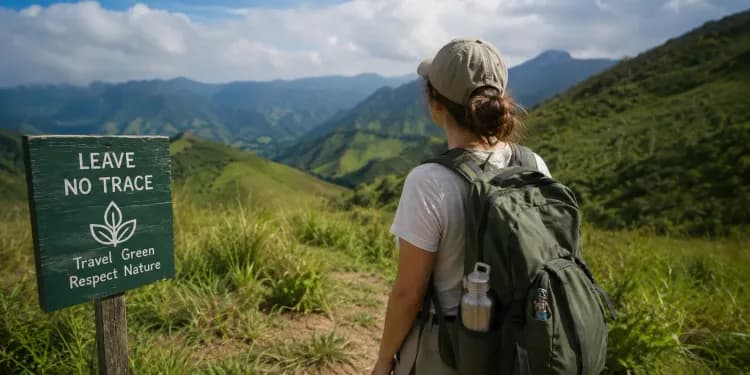
The simplest rule: if you carried it in, carry it out. In natural areas - beaches, forests, trekking trails, campsites - leave no trace. In cities, use the bins. Where recycling facilities exist, use them. When you're in remote areas without infrastructure, carry a small bag and bring your waste back to where it can be properly disposed of.
This is basic, but it matters. Some of India's most beautiful trekking routes, hill stations, and natural reserves are seriously degraded by accumulated visitor waste. The same is true of international destinations across Southeast Asia, the Himalayas, and beyond. Every traveller who cleans up after themselves - and occasionally picks up something they didn't drop - is making a tangible contribution.
Choose Activities That Don't Cost the Earth
The travel industry offers no shortage of experiences that are either outright harmful or ethically murky - elephant rides, wildlife selfie attractions, shows using animals trained through questionable methods, diving operators who let guests stand on coral reefs.
A simple approach: if an animal is performing, posing for photos, or in an unnatural setting, research it before booking. Organisations like World Animal Protection maintain guidance on responsible wildlife tourism that's worth a look before you commit.
Better alternatives are rarely hard to find: guided nature walks, community-based cultural experiences, heritage tours, cooking classes with local families, cycling through rural landscapes. These tend to be more memorable anyway.
Go Digital Wherever You Can
This is the easiest win in sustainable travel and one that also just makes your life simpler.
E-visas, digital boarding passes, electronic hotel confirmations, downloaded maps, and digital copies of your travel documents - all of these reduce paper consumption and, more practically, reduce the number of things you can lose. Mera Visa Guide is a good example of how the entire visa application and documentation process can now be navigated without printing a single sheet, where regulations allow.
A few useful habits:
• Enable digital boarding passes on your airline app
• Store copies of all travel documents in a cloud folder accessible offline
• Download destination maps for offline use before arrival
• Use navigation apps that adapt to real-time conditions rather than printed itineraries
Sustainable Travel Is Often Cheaper, Not More Expensive
Here's the part that surprises many people: a lot of sustainable travel choices save money rather than cost more.
Packing lighter means avoiding checked baggage fees. Taking public transport instead of taxis cuts costs in almost every city in the world. Eating at local restaurants is usually far cheaper than tourist-facing international chains. Carrying a reusable bottle eliminates dozens of small plastic water bottle purchases across a two-week trip. Staying at locally owned guesthouses frequently offers better value than brand-name alternatives.
Sustainable travel as a luxury product - bamboo resorts, premium carbon offsets, expensive eco-lodges - exists and is fine if that's your budget. But it's entirely optional. The most meaningful sustainable choices are available to every traveller, at every price point.
Consider Travelling During the Shoulder Season
Not every destination needs more visitors during its busiest month. Travelling during the shoulder season - the weeks just before or after peak tourist periods - can help reduce pressure on overcrowded destinations while offering a more relaxed experience for visitors.
The benefits go beyond sustainability. Flights and accommodation are often more affordable, attractions are less crowded, and local businesses benefit from a steadier flow of tourism throughout the year rather than a short burst of peak-season demand.
In many cases, you'll end up with a better trip while leaving a lighter footprint.
Travel Better, Not Just Further
Sustainable travel isn't necessarily about travelling less. In many cases, it's about travelling more thoughtfully.
The choices that make a trip more sustainable are often the same choices that make it more rewarding: taking the train instead of rushing through an airport, spending an extra day in one destination rather than trying to tick off three, eating at a local restaurant where the owner remembers your name instead of a place that looks exactly like home, and walking through a neighbourhood instead of watching it pass by through a taxi window.
Travel has always been about connection - with people, places, cultures, and experiences that are different from our own. Sustainable travel simply asks us to approach those connections with a little more awareness.
Every destination you visit will welcome thousands of travellers this year. The difference isn't whether you travel; it's how you travel. Being mindful of the waste you create, the businesses you support, the wildlife you interact with, and the communities you visit helps ensure those places remain special for the people who live there and for future travellers.
You travelled to see the world. A little thoughtfulness helps make sure the world stays worth seeing.
Quick Sustainable Travel Checklist
Before your next trip:
• Pack lighter - one bag less is one step better
• Carry a reusable water bottle and tote bag
• Switch to solid toiletry bars to reduce plastic packaging
• Download offline maps and go digital with all documents
• Research eco-conscious or locally owned accommodation options
• Book at least one locally run restaurant or tour operator per destination
• Check wildlife experience guidelines before booking animal-related activities
• Use public transport wherever it's practical and safe
• Keep a small bag for waste when visiting natural areas
• Consider direct flight routing when price and timing are comparable
Other topics
Explore and Discover

Planning a Ski Trip Abroad? Here's Why Standard Travel Insurance May Not Be Enough
Thursday, Jul 9, 2026
While standard travel insurance covers common travel risks, it may not include winter sports-related accidents, equipment damage, or emergency mountain rescue.

Why Smart Travellers Never Skip Travel Insurance: Lessons from Real-Life Mishaps
Thursday, Jul 9, 2026
Discover why travel insurance is an essential part of every trip. Learn from real-life travel mishaps—from medical emergencies and lost baggage to flight cancellations and passport issues.

Holiday Travel Checklist: Must Have Essentials for a Stress Free Trip
Thursday, Jul 9, 2026
Planning a holiday? Stay organized and travel with confidence using this complete holiday travel checklist. From essential documents and packing must-haves to health, safety, and tech essentials, discover everything you need for a smooth, stress-free trip and enjoy your vacation without last-minute surprises.